
IPTV Encoder Encoders are the unsung heroes behind every successful IPTV service, transforming raw video signals into a streamable format. Understanding the intricacies of IPTV Encoder Encoders is crucial for anyone looking to enter or optimize their presence in the rapidly expanding world of internet protocol television. These powerful devices and software solutions are at the heart of content delivery, ensuring high-quality, reliable, and efficient streaming experiences for viewers worldwide.
From live broadcasts to on-demand content, the performance of your IPTV Encoder Encoders directly impacts user satisfaction and the overall success of your IPTV platform. As technology evolves, so too do the capabilities and complexities of these essential tools. This guide will delve deep into everything you need to know about them.
Table of Contents
- What are IPTV Encoder Encoders and Why Are They Essential?
- Types of IPTV Encoder Encoders: Hardware vs. Software
- Key Features to Look for in IPTV Encoder Encoders
- Optimizing Performance with Advanced IPTV Encoder Encoders
- IPTV Encoder Encoders and the Future of Streaming in 2025
- Common Challenges and Solutions with IPTV Encoder Encoders
- Choosing the Right IPTV Encoder Encoders for Your Business
- FAQ About IPTV Encoder Encoders
- Related IPTV Services
What are IPTV Encoder Encoders and Why Are They Essential?
At its core, an IPTV encoder (or more accurately, an encoder for IPTV) is a device or software that converts video and audio signals from their original source into a digital format suitable for transmission over an IP network. The term “IPTV Encoder Encoders” often refers to the broader category of these encoding solutions used within the IPTV ecosystem. Without these critical components, traditional broadcast signals or raw video files simply couldn’t be delivered via the internet. They take analog or uncompressed digital signals, compress them using various codecs (like H.264 or H.265), and package them into streamable formats (like MPEG-TS or HLS).
The essential nature of IPTV Encoder Encoders cannot be overstated. They are the first step in the content delivery chain, directly impacting the quality, latency, and bandwidth consumption of your streams. A well-chosen and configured encoder can significantly reduce operational costs by optimizing bandwidth usage while maintaining excellent video quality. Conversely, a poor encoding solution can lead to pixelated video, audio sync issues, and excessive buffering, driving users away.
In 2025, with increasing demands for 4K and even 8K content, coupled with the proliferation of mobile devices, the role of advanced IPTV Encoder Encoders becomes even more critical. They must be capable of handling higher resolutions, supporting multiple adaptive bitrate (ABR) profiles, and integrating seamlessly with content delivery networks (CDNs) and other IPTV infrastructure components. The right encoding strategy ensures that your content reaches every viewer, regardless of their device or internet connection speed.
Moreover, modern IPTV Encoder Encoders often include features beyond basic compression, such as ad insertion capabilities, digital rights management (DRM) integration, and metadata embedding. These advanced functionalities enable content providers to monetize their streams effectively and protect their intellectual property, making the encoder a central piece of a comprehensive IPTV solution.
Types of IPTV Encoder Encoders: Hardware vs. Software
When selecting IPTV Encoder Encoders, one of the primary decisions revolves around choosing between hardware-based and software-based solutions. Both have distinct advantages and disadvantages, and the best choice often depends on the specific needs, scale, and budget of your IPTV operation. Understanding these differences is key to making an informed decision about your IPTV Encoder Encoders.
Hardware encoders are dedicated physical devices designed specifically for video encoding. They often feature specialized chips (ASICs or FPGAs) that are highly efficient at processing video data, leading to lower latency and higher quality output, especially for demanding tasks like live 4K encoding. These devices are typically robust, reliable, and built for continuous operation in professional environments. Examples include rack-mountable units from manufacturers specializing in broadcast equipment. While they represent a significant upfront investment, their performance and stability can justify the cost for large-scale operations requiring maximum uptime.
Software encoders, on the other hand, run on general-purpose computers or servers. They leverage the CPU and sometimes the GPU of the host system to perform encoding tasks. Software-based IPTV Encoder Encoders offer greater flexibility, scalability, and often a lower entry barrier in terms of cost. They can be easily updated, configured, and integrated with other software components. Cloud-based encoding services are a prime example of software encoding, allowing providers to scale their encoding capacity dynamically based on demand. While they might not always match the raw, low-latency performance of dedicated hardware for every scenario, advancements in processor technology and software optimization have made them incredibly powerful and efficient for a wide range of IPTV applications.
Many modern IPTV setups utilize a hybrid approach, combining the strengths of both. For instance, critical live feeds might be handled by hardware IPTV Encoder Encoders for maximum reliability and low latency, while VOD content or less critical streams could be processed by scalable software encoders running in the cloud. The choice ultimately depends on factors like budget, required quality, latency tolerance, scalability needs, and the technical expertise available for management. When evaluating compatible devices, consider how well the chosen encoding solution integrates.
Key Features to Look for in IPTV Encoder Encoders
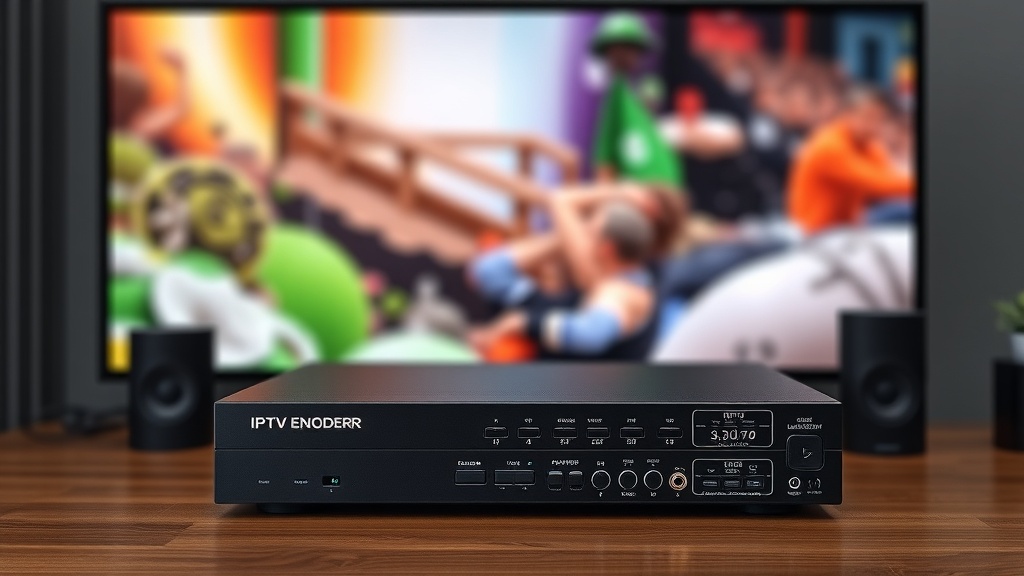
Selecting the right IPTV Encoder Encoders involves a careful evaluation of several key features that directly impact performance, flexibility, and cost-effectiveness. As the IPTV landscape evolves, so do the expectations for these critical devices. Here’s what to prioritize:
- Codec Support: Modern IPTV Encoder Encoders should support a wide range of codecs, with H.264 (AVC) and H.265 (HEVC) being paramount. H.265 offers superior compression efficiency, delivering the same quality at half the bitrate of H.264, which is crucial for 4K content and bandwidth-constrained environments. Support for older codecs might also be necessary for backward compatibility.
- Resolution and Frame Rate: Ensure the encoder can handle the resolutions and frame rates you intend to stream, from SD to Full HD, 4K, and potentially 8K. High frame rates (e.g., 60fps) are essential for sports and fast-moving content to ensure a smooth viewing experience.
- Adaptive Bitrate (ABR) Streaming: This is a non-negotiable feature for any serious IPTV service. ABR allows the encoder to create multiple versions of the same stream at different bitrates and resolutions. This enables players to dynamically switch between streams based on the viewer’s internet speed and device capabilities, ensuring optimal quality without buffering.
- Input/Output Interfaces: Depending on your source, you’ll need appropriate input interfaces. Common options include HDMI, SDI, DVI, Component, and IP inputs (like NDI or SRT). For output, Ethernet ports for IP streaming are standard.
- Latency: For live events, ultra-low latency is critical. Some IPTV Encoder Encoders are specifically designed to minimize the delay between the source and the viewer, often achieving sub-second latency.
- Scalability and Reliability: For larger operations, the ability to scale encoding capacity up or down quickly is crucial. Hardware encoders offer robust, dedicated performance, while cloud-based software encoders excel in dynamic scalability. Redundancy features are also important to ensure continuous service.
- Integration and Management: Look for encoders that offer intuitive management interfaces (web-based GUIs are common) and API access for integration with other systems like content management systems (CMS), digital rights management (DRM) platforms, and monitoring tools.
- Audio Encoding: Beyond video, robust audio encoding (e.g., AAC, AC3) with support for multiple audio tracks and surround sound is vital for a complete viewing experience.
- Transcoding Capabilities: While encoding converts raw signals, transcoding converts an already encoded stream into a different format or bitrate. Many advanced IPTV Encoder Encoders offer powerful transcoding features, essential for delivering content to a diverse range of devices.
- Security Features: Support for encryption and integration with DRM systems is crucial for protecting your content from unauthorized access and piracy.
Optimizing Performance with Advanced IPTV Encoder Encoders
Achieving optimal performance with IPTV Encoder Encoders goes beyond simply selecting the right hardware or software; it involves strategic configuration, continuous monitoring, and leveraging advanced features. In 2025, the demand for pristine quality and minimal latency means that every aspect of your encoding pipeline must be finely tuned.
One of the primary optimization techniques is intelligent bitrate management. While higher bitrates generally mean better quality, they also consume more bandwidth. Advanced IPTV Encoder Encoders allow for granular control over bitrate settings, including variable bitrate (VBR) and constant bitrate (CBR) encoding, as well as sophisticated rate control algorithms. Properly configuring these can significantly reduce bandwidth usage without a noticeable drop in perceived quality. This is particularly important when considering IPTV pricing models, as bandwidth costs can be a major factor.
Another critical aspect is the effective use of adaptive bitrate (ABR) profiles. Instead of creating a generic set of profiles, analyze your audience’s typical internet speeds and device capabilities. Tailoring your ABR ladder to these real-world conditions can ensure that viewers consistently receive the best possible stream. Modern IPTV Encoder Encoders can even dynamically adjust these profiles based on network conditions in real-time, offering unparalleled adaptability.
Leveraging GPU acceleration is another powerful optimization. Many software IPTV Encoder Encoders can offload computationally intensive encoding tasks to dedicated graphics processing units, significantly speeding up the encoding process and freeing up CPU cycles for other tasks. This is especially beneficial for high-resolution (4K/8K) and high frame rate content, or when processing multiple streams concurrently.
Furthermore, consider the integration of your IPTV Encoder Encoders with a robust CDN (Content Delivery Network). While the encoder handles the initial stream creation, the CDN ensures efficient delivery to end-users globally. A tightly integrated system minimizes latency and improves reliability, especially during peak viewing times. The choice of encoding parameters should also take into account the CDN’s capabilities and recommendations.
Finally, continuous monitoring and analytics are essential. Tracking metrics like stream health, error rates, and viewer experience allows you to identify bottlenecks and fine-tune your encoder settings for ongoing optimal performance. Many advanced IPTV Encoder Encoders come with built-in monitoring tools or integrate with third-party analytics platforms, providing invaluable insights into your streaming operation.
IPTV Encoder Encoders and the Future of Streaming in 2025
The landscape of streaming television is constantly evolving, and the role of IPTV Encoder Encoders is becoming increasingly sophisticated to meet the demands of emerging technologies and viewer expectations. As we look towards 2025, several trends are shaping the future of these critical components.
One major trend is the widespread adoption of AV1 and VVC (Versatile Video Coding) codecs. While H.265 (HEVC) is currently dominant for high-efficiency encoding, AV1, an open-source, royalty-free codec, is gaining significant traction due to its superior compression efficiency. VVC, the successor to HEVC, promises even greater improvements. Future IPTV Encoder Encoders will need to offer robust support for these codecs to enable higher quality streams at lower bitrates, further reducing bandwidth costs and improving accessibility for users with slower internet connections. This will be a significant factor for providers offering extensive channel packages.
Another crucial development is the increasing emphasis on low-latency and ultra-low-latency streaming. For interactive content, live sports, and real-time events, traditional streaming protocols introduce too much delay. Protocols like SRT (Secure Reliable Transport) and WebRTC are becoming more prevalent, and next-generation IPTV Encoder Encoders are being designed to natively support these, enabling near real-time experiences. This is especially important for applications like remote production and interactive live broadcasts.
The rise of AI and machine learning in video processing is also set to revolutionize IPTV Encoder Encoders. AI can be used for intelligent content-aware encoding, where the encoder analyzes the video content frame by frame and applies optimal compression settings. This can lead to significant bitrate savings without compromising quality. AI can also assist in upscaling lower-resolution content to 4K or even 8K, and in enhancing video quality in real-time, delivering a premium viewing experience even from less-than-perfect sources.
Furthermore, expect to see greater integration of cloud-native encoding solutions. The flexibility and scalability of cloud platforms are perfectly suited for the dynamic nature of streaming. Cloud-based IPTV Encoder Encoders can spin up resources on demand, making them ideal for handling sudden spikes in viewership or processing large volumes of VOD content. This shift towards cloud infrastructure will also foster greater automation and orchestration of encoding workflows.
Finally, the evolution of immersive experiences like VR and AR will place new demands on IPTV Encoder Encoders. These formats require specialized encoding techniques, often involving 360-degree video and complex spatial audio. Encoders will need to adapt to these new content types, ensuring efficient compression and delivery for truly immersive viewing. The future of IPTV Encoder Encoders is bright, promising more efficient, intelligent, and flexible solutions.
Common Challenges and Solutions with IPTV Encoder Encoders
While IPTV Encoder Encoders are indispensable, their implementation and management can present several challenges. Understanding these hurdles and their solutions is critical for maintaining a robust and high-quality IPTV service.
Challenge 1: Bandwidth Constraints vs. Quality Demands. Viewers always demand the highest quality, but internet bandwidth isn’t infinite. Delivering 4K content, especially to mobile users, can quickly exhaust available bandwidth, leading to buffering.
Solution: Implement aggressive adaptive bitrate (ABR) streaming profiles. Utilize advanced codecs like H.265 (HEVC) or AV1 which offer superior compression. Content-aware encoding, where the encoder intelligently adjusts bitrate based on scene complexity, can also provide significant savings without visual degradation. Employing a robust CDN is also key to efficiently distributing the load.
Challenge 2: High Latency in Live Streams. For live sports, news, or interactive events, even a few seconds of delay can ruin the experience. Traditional streaming protocols often introduce significant latency.
Solution: Choose IPTV Encoder Encoders that specifically support low-latency protocols like SRT (Secure Reliable Transport) or WebRTC. Optimize encoder settings for minimal buffering and processing delay. Ensure your entire delivery chain, including the CDN and player, is configured for low latency. Dedicated hardware encoders often provide the lowest possible latency.
Challenge 3: Scalability for Fluctuating Audiences. IPTV services can experience massive swings in viewership, especially during major events. Scaling encoding resources up and down efficiently can be difficult with fixed infrastructure.
Solution: Embrace cloud-based software IPTV Encoder Encoders. Cloud platforms offer elastic scalability, allowing you to dynamically provision and de-provision encoding resources as needed. This “pay-as-you-go” model is cost-effective for managing unpredictable demand. Hybrid solutions, combining on-premise hardware for base load and cloud for peak demand, are also effective.
Challenge 4: Content Security and Piracy. Protecting valuable content from unauthorized access and piracy is a constant battle.
Solution: Integrate Digital Rights Management (DRM) systems with your IPTV Encoder Encoders. Encoders should support encrypting streams (e.g., using AES-128) and packaging content for various DRM schemes (e.g., Widevine, PlayReady, FairPlay). Watermarking techniques can also help trace the source of pirated content.
Challenge 5: Complexity of Management and Integration. Modern IPTV ecosystems involve numerous components, and managing IPTV Encoder Encoders alongside other systems can be complex and resource-intensive.
Solution: Opt for encoders with intuitive web-based management interfaces and robust APIs for automation. Look for solutions that integrate well with existing CMS, transcoders, and monitoring platforms. Employing a unified video platform or orchestration layer can simplify the overall workflow and reduce operational overhead.
Choosing the Right IPTV Encoder Encoders for Your Business
The decision of which IPTV Encoder Encoders to deploy is a critical one that can significantly impact your business’s success, cost structure, and ability to deliver a high-quality streaming experience. There’s no one-size-fits-all answer, as the best choice depends on a multitude of factors specific to your operation.
Firstly, consider your content type and volume. Are you primarily streaming live events, VOD content, or a mix of both? Live streaming demands lower latency and higher reliability, often favoring dedicated hardware IPTV Encoder Encoders or highly optimized cloud solutions. VOD content allows for more extensive processing time, making scalable cloud software encoders a very attractive option for efficiency and cost. The sheer volume of content also dictates the processing power needed.
Next, evaluate your target audience and their devices. Are your viewers primarily on smart TVs, mobile phones, or web browsers? This will influence the required output formats, codecs, and adaptive bitrate profiles. An IPTV service targeting high-end 4K TVs will have different encoding requirements than one focused on mobile users with varying internet speeds.
Budget constraints are always a significant factor. Hardware IPTV Encoder Encoders typically involve a higher upfront capital expenditure but may offer lower operational costs over time for continuous, high-volume encoding. Software and cloud-based solutions often have lower entry costs and a more flexible operational expenditure model, scaling with usage. When comparing IPTV service costs, remember to factor in encoding expenses.
Scalability and future-proofing are also paramount. Will your service grow rapidly? Do you anticipate moving into new regions or offering new types of content (e.g., 8K, VR)? Choose IPTV Encoder Encoders that can adapt to future demands without requiring a complete overhaul of your infrastructure. Cloud solutions inherently offer excellent scalability, but some hardware encoders can also be clustered for increased capacity.
Consider your technical expertise and operational resources. Do you have a dedicated team to manage complex hardware installations and configurations, or would you prefer a more managed, user-friendly software or cloud-based solution? The ease of integration with your existing content management systems, DRM platforms, and monitoring tools is also vital.
Finally, always perform thorough testing. Before committing to a large-scale deployment, test different IPTV Encoder Encoders with your actual content, network conditions, and target devices. Evaluate the output quality, latency, and resource utilization to ensure the chosen solution meets your specific performance benchmarks. A well-informed decision now will save significant time and resources in the long run.
FAQ About IPTV Encoder Encoders
Q1: What is the primary function of an IPTV encoder?
The primary function of an IPTV encoder is to convert raw video and audio signals into a digital, compressed format suitable for transmission over an Internet Protocol (IP) network. This process, often referred to as encoding, makes it possible to stream content efficiently to various devices, forming the backbone of any IPTV service.
Q2: What’s the difference between encoding and transcoding in the context of IPTV Encoder Encoders?
Encoding refers to the initial conversion of an uncompressed analog or digital video signal into a compressed digital stream. Transcoding, on the other hand, is the process of converting an already encoded digital stream from one format, codec, or bitrate to another. Both are crucial for delivering content effectively across diverse networks and devices, and many advanced IPTV Encoder Encoders perform both functions.
Q3: Why is adaptive bitrate (ABR) streaming important for IPTV Encoder Encoders?
ABR streaming is critical because it allows the IPTV encoder to create multiple versions of a video stream at different bitrates and resolutions. This enables video players to dynamically switch between these versions based on the viewer’s internet speed and device capabilities, ensuring the best possible quality without buffering, thereby enhancing the user experience significantly.
Q4: Should I choose hardware or software IPTV Encoder Encoders?
The choice between hardware and software IPTV Encoder Encoders depends on your specific needs. Hardware encoders typically offer lower latency and higher dedicated performance for demanding live streams, but come with a higher upfront cost. Software encoders provide greater flexibility, scalability, and often a lower entry cost, making them ideal for VOD and dynamic scaling, especially in cloud environments. Many operations use a hybrid approach.
Q5: How do IPTV Encoder Encoders contribute to content security?
IPTV Encoder Encoders contribute to content security by supporting encryption of the video streams and integrating with Digital Rights Management (DRM) systems. They can package the encoded content in formats compatible with DRM protocols (like Widevine, PlayReady), ensuring that only authorized users with valid licenses can access and view the content, thereby preventing piracy.
Related IPTV Services
You may also visit the following websites for similar services: